
This time, the algorithm worked in favor of those demanding democratic and anti-corruption change. Next time, it may work in the opposite direction.
The government resigned after record-breaking mobilization. This was not simply a quantitative peak, but a sign of a shift in how society shapes its public conversation.
Before the familiar cycle of returned mandates, caretaker governments, elections, and new mandates begins again, it is important to examine the mechanisms and tools that drove this protest. It was not only organized. It was livestreamed on TikTok and revealed a change in social reality and generational dynamics.
This was not a protest of Generation Z alone, but that generation provided the spark. Data shows participation across the entire “network generation” (ages 20–50), people for whom social media is the primary environment for communication and mobilization.
Traditional Bulgarian media, heavily influenced by political and economic interests, no longer set the agenda as they did in previous years. Social media is becoming the main space where social discourse takes shape. This is where the public conversation happens: where the problem lies, who bears responsibility, and what kind of change is expected.
The protest was not created or sustained solely on TikTok. However, the platform’s algorithms enable rapid publishing and massive amplification of emotionally powerful content.
That content generates high viral engagement, which then spills over into other social networks.
These conclusions are based on social media monitoring analysis conducted by Sensika Technologies. Approximately 66,000 protest-related posts and comments were analyzed between November 1 and December 11. This includes over 42,700 from Facebook, more than 16,300 from Twitter, over 3,000 from Telegram, and a focused analysis of the 200 most-viewed TikTok videos from the past month. A smaller number of Instagram and YouTube posts were also included.
Protest Mobilization
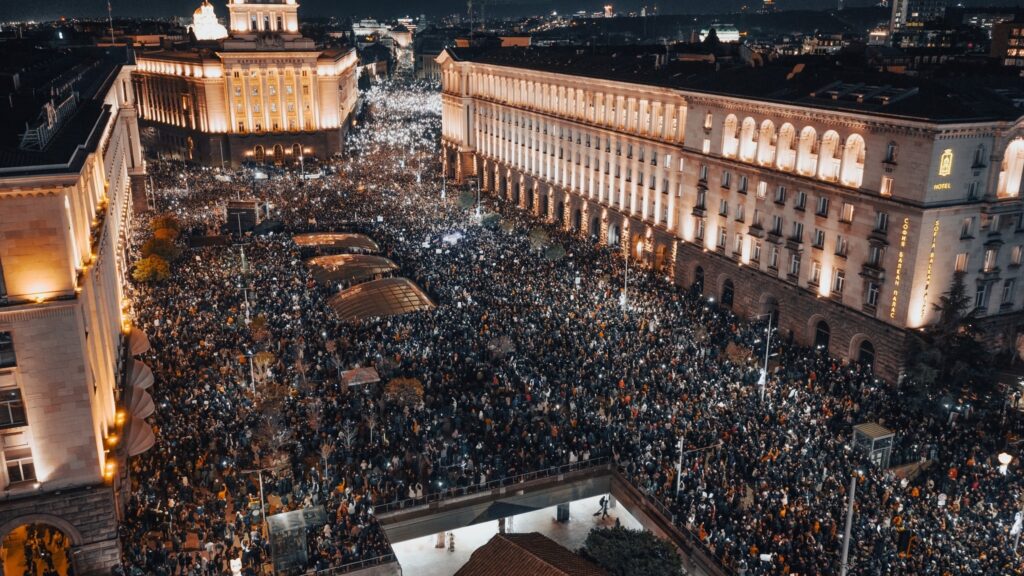
In 2025, the median daily volume of posts related to protests was about 260. The previous wave of anti-euro protests, organized by the Vazrazhdane party and pro-Russian networks, did not exceed 800 to 1,200 posts per day.
Against this background, the protest peaks in November and December were unprecedented:
- November 26: 2,938 posts (11 times above the median)
- December 1: 6,873 posts (26 times above the median)
- December 2: 9,398 posts (36 times above the median, the highest peak of the year)
- December 10: 4,749 posts (18 times above the median)
High engagement around the protests indicates more than reactive sharing. It reflects rapid, targeted participation in real time.
“Who Ordered This Outrage?”
No protest emerges on its own without underlying social tension. In this case, tension had been accumulating across several periods. Part of it came from the anti-euro protests, another part from public outrage over a dog killed by a doctor, and a third from protests against the arrest of Varna’s mayor, Blagomir Kotsev.
The real trigger, however, was the emergency meeting of the Budget Committee on November 26.
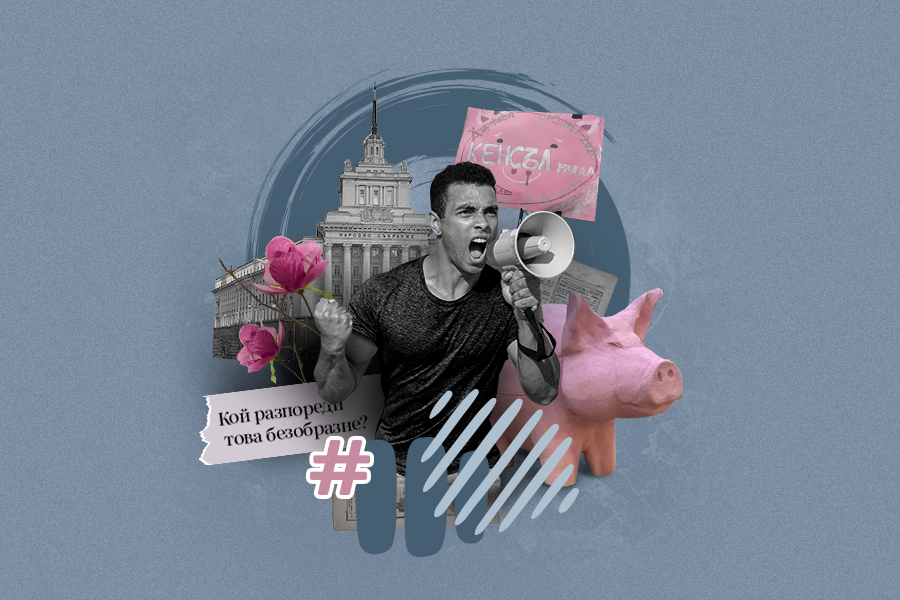
Post volumes spiked as early as 2 PM, driven by livestreams and the phrase “Who ordered this outrage?”, spoken by Asen Vassilev.
By December 15, TikTok featured more than 50 videos using the hashtag #койразпоредитовабезобразие (“Who ordered this outrage”), generating close to one million views. In reality, their reach was much broader, since not all videos used the hashtag or included the phrase in their descriptions.
The first videos appeared on November 26 and coincided with a sharp increase in the use of the word “protest” across all social platforms. From early afternoon to the evening peak, the volume of posts tripled.
The protest behaved like a living organism: it reacted, evolved, and moved through clearly distinguishable phases.
Between November 20 and December 10, content volume shifted from a relatively stable range of 400 to 1,000 posts per day to the first major surge on November 26. That day, nearly 3,000 posts were detected across social platforms, engaging more than 550,000 people through likes, comments, and shares.
Historic peaks followed on December 1 and December 10.
Each surge was a direct reaction to a different stimulus.
On the first day, it was the 2026 budget and the Budget Committee scandal. On the second, the protests escalated after clashes following 10 PM on December 1. On December 10, the trigger was counter-protests and the absence of a political solution.
Keyword analysis shows that with each phase, both the narrative and the direction of the protest shifted. It began with “taxes,” moved to “abuse of power” and “escalation,” and ultimately became “government versus society.” The protest transformed from economic dissatisfaction into a crisis of political legitimacy.
Protest Pop Culture and Viral Power
TikTok did more than distribute protest messages. It transformed them into pop culture artifacts that, in turn, fueled mobilization.
Phrases such as “Who ordered this outrage?” and the insult “vermin,” used by MP Bayram Bayram of the “Novo Nachalo” party, did not merely become popular. They entered an algorithmic amplification cycle, where daily view counts exceeded the growth in new video uploads. This meant the same clips were watched far more often than would be expected under the linear logic of platforms such as Facebook, Instagram, or X.
On December 3, the day with the strongest meme activity, the Viral Acceleration Index reached an additional 6,500 views per video. This metric measures how much total video views increase each day relative to the number of new videos published that day.
This is a clear indicator that memes and musical remixes were heavily circulated on the For You page and widely reshared through posts and stories.
The For You page is where TikTok promotes content it deems important and popular, operating on a simple feedback logic: the more engagement, the more visibility.
Remixes of “outrage,” trap versions of “vermin,” and visual interpretations of the piggy-bank motif linked to the Peppa Pig meme icon served not only a cultural function, but an algorithmic one. They expanded the protest’s reach, extended the lifespan of content, and generated new waves of views even on days without offline events. This is what transformed the protest from a political event into a cultural phenomenon. TikTok captured emotion, turned it into formats designed for imitation, remixing, and duets, and then distributed it exponentially through the algorithm. High engagement rates of 10 to 20 percent and repeated viewership peaks of 3 to 3.5 million at key moments show that meme culture was not peripheral to the protest. It was its primary propulsion mechanism.
Not Anti-European, Not Limited to the Capital
Despite attempts by Vazrazhdane and pro-Russian networks to hijack the momentum, as well as efforts by the authorities to label the protest as anti-European, the movement was not directed against the euro.
Keyword analysis from the past 30 days shows no dominant euro-related terms. The most frequently used keywords were “protest,” “government,” “resignation,” “Peevski,” “corruption,” “taxes,” and “budget.” Words such as “euro” or “eurozone” appeared in very low volumes, well below trend thresholds, and came mainly from pro-Russian Telegram sources and political commentators, not from protesters themselves.
On Telegram, only 3 to 5 percent of content containing the word “protest” mentioned the euro, with nearly all such posts originating from pro-Russian or anti-EU channels.
The protest was not a Sofia-only phenomenon. A significant share of the most-viewed videos came from Plovdiv, Varna, Burgas, Ruse, Stara Zagora, and from the Bulgarian diaspora, making the mobilization national in scope. This time, the algorithm worked in favor of pro-European content. That was not the case during last year’s elections.