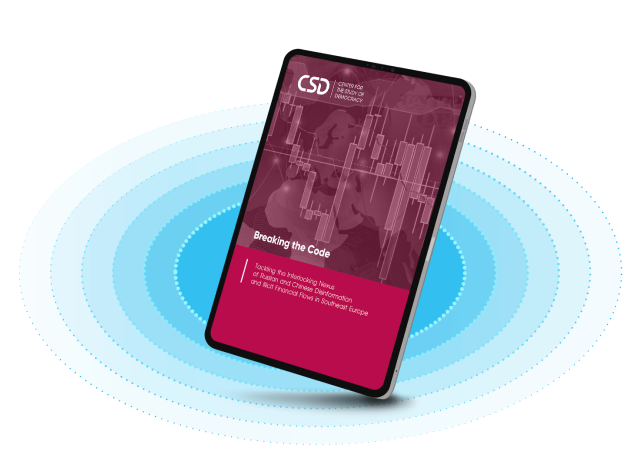

Breaking the Code examines how foreign disinformation activities in Southeast Europe intersect with illicit financial flows (IFFs) and structural weaknesses in media governance. Published by the Center for the Study of Democracy (CSD), the report provides a regional assessment of how financial opacity and media capture create conditions that enable sustained information influence.
The study covers eight countries — Albania, Bosnia and Herzegovina, Bulgaria, Croatia, Kosovo, Montenegro, North Macedonia, and Serbia — identifying common vulnerabilities despite differing political and regulatory environments. One of the report’s key findings is that illicit financial flows in the region amount to approximately six percent of regional GDP, significantly above global averages. These financial channels intersect with strategic sectors such as media, infrastructure, and telecommunications, where economic leverage may influence information ecosystems.
Structural mechanisms of influence
Rather than focusing on isolated cases of false information, the report analyzes structural mechanisms that allow disinformation to persist over time. Media capture is described as operating through indirect pressures, including advertising dependence, regulatory favoritism, opaque ownership structures, and political affiliations.
Within such environments, disinformation does not always appear as fabricated content. Instead, it may emerge through selective framing, amplification of aligned messaging, and repetition of narratives across multiple outlets. These practices gradually shape public discourse while remaining difficult to trace without systematic monitoring.
Russian and Chinese influence strategies
The report distinguishes between Russian and Chinese approaches to information influence in Southeast Europe. Russian actors benefit from longstanding media relationships and legacy networks that have developed over decades.
Chinese influence, while more recent, is expanding through investment projects, technology cooperation, and partnerships that intersect with existing media and economic structures. Social media platforms further accelerate the circulation of coordinated narratives across borders, amplifying messaging beyond traditional media channels.
Sensika’s contribution
Sensika provided structured media monitoring data used in the report’s empirical assessment of pro-Kremlin narratives across mainstream and locally aligned outlets in Southeast Europe. The platform enabled comparative analysis of narrative frequency, media coverage patterns, and cross-country trends referenced throughout the report’s analytical sections.
All findings, interpretations, and policy conclusions remain those of the Center for the Study of Democracy.
Access the full report
Breaking the Code offers a detailed examination of how financial opacity, media capture, and geopolitical influence intersect within Southeast Europe’s information environment.