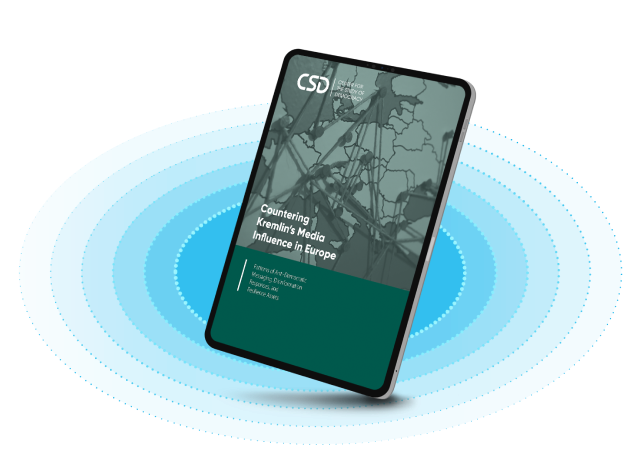

Countering Kremlin’s Media Influence in Europe examines the patterns, narratives, and intensity of Russian anti-democratic disinformation across four EU member states: Bulgaria, the Czech Republic, Germany, and Poland.
The report combines qualitative content analysis with automated quantitative diagnostics to assess how pro-Kremlin messaging circulates across different types of media outlets. These include Russian state-owned platforms, partisan outlets, broader national dailies, and mainstream sources used as comparative control cases.
The analysis identifies recurring themes in Russian anti-democratic messaging, including nationalist rhetoric, anti-migrant narratives, misogynistic discourse, and economically illiberal positioning. The report also evaluates how the prominence and intensity of these narratives vary across national media ecosystems.
Comparative assessment of resilience
Beyond mapping disinformation patterns, the report evaluates the resilience of national information environments. The analysis considers several dimensions, including governance and policy-making frameworks, the role of civil society in countering disinformation, and participation in EU and international initiatives addressing foreign influence operations.
The study highlights important differences between countries in their institutional responses to disinformation. Some states have developed coordinated frameworks for strategic communication and media transparency, while others rely more heavily on civil society actors and independent media initiatives.
By linking narrative analysis with a structural assessment of resilience, the report provides a comparative European perspective on the vulnerabilities and response capacities within the digital information ecosystem.
Sensika’s contribution
Automated quantitative diagnostics referenced in the report were conducted using Sensika’s content tracking platform. The tool enabled analysis of article volume and the intensity of Kremlin-related messaging across selected media outlets.
Sensika’s data supported the measurement of messaging presence across multiple countries, complementing the report’s qualitative content analysis.
All findings, interpretations, and policy conclusions remain those of the Center for the Study of Democracy.
Access the full report
Countering Kremlin’s Media Influence in Europe provides a comparative assessment of anti-democratic messaging patterns and resilience assets across European information ecosystems.