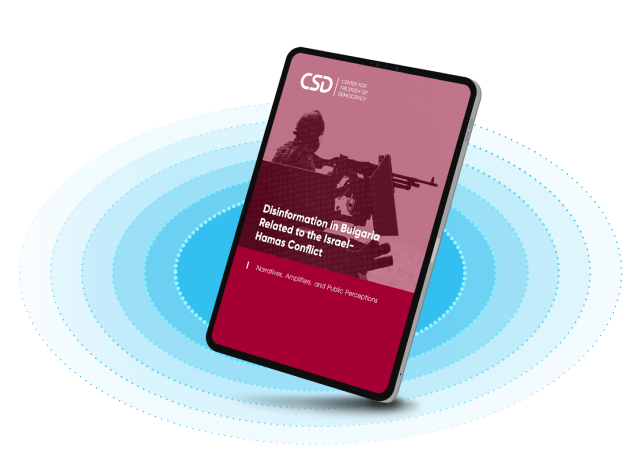

Disinformation in Bulgaria Related to the Israel–Hamas Conflict examines how pro-Kremlin actors exploited the escalation in Gaza to amplify anti-Western narratives and deepen societal divisions within Bulgaria’s media environment.
The report analyzes online media coverage, Facebook activity, and Telegram channels between October 2023 and October 2024. It identifies a coordinated ecosystem of pro-Russian outlets, so-called “mushroom” websites duplicating identical content across multiple domains, and Telegram channels that intensify narrative spikes during major geopolitical developments.
Amplifiers and narrative patterns
The study finds that established pro-Russian outlets and anonymous cloned websites played a central role in amplifying misleading narratives. Content was repeatedly republished across platforms to maximize reach, particularly in the early days of the conflict.
Telegram channels further reinforced these disinformation surges, timing their messaging around major conflict developments involving regional actors such as Iran and Lebanon. The report documents how these moments corresponded with sharp increases in message volume and audience engagement.
Recurring narratives portrayed the West as orchestrating proxy wars in both Ukraine and Gaza, alleged that Ukraine was supplying weapons to Hamas, and claimed that Israel exercises unchecked influence over global geopolitics. Conspiracy narratives linking global power structures to secretive elite networks were also widely circulated.
The report highlights that contradictory narratives were often deployed simultaneously — a tactic designed less to persuade audiences consistently than to generate confusion and erode trust in reliable information sources.
Youth perceptions and susceptibility
An online survey of young Bulgarians aged 16–25 reveals low awareness of the Israel–Hamas conflict and considerable uncertainty about the accuracy of available information. While many respondents remained undecided about specific claims, anti-Western and anti-EU/NATO narratives showed relatively higher levels of acceptance.
The findings suggest that narratives connected to domestic political issues — including those related to Ukraine, energy prices, and EU membership — resonate more strongly with audiences than distant geopolitical conflicts.
Policy implications
The report outlines several policy recommendations aimed at strengthening resilience against foreign information manipulation. These include enforcing EU sanctions targeting Kremlin-linked media, addressing content amplification networks, strengthening strategic communication capacity, and improving media literacy among younger audiences.
By combining narrative tracking, amplification analysis, and public opinion research, the study provides a comprehensive assessment of how foreign information manipulation operates within Bulgaria’s digital ecosystem.
Sensika’s contribution
Online media coverage and engagement metrics were collected and analyzed using Sensika’s media intelligence platform. The monitoring infrastructure supported structured tracking of more than 2,500 Bulgarian news websites and enabled comparative analysis of narrative spikes, amplification networks, and cross-platform dissemination patterns.
All findings, interpretations, and policy recommendations remain those of the Center for the Study of Democracy.
Access the full report
Disinformation in Bulgaria Related to the Israel–Hamas Conflict provides a detailed examination of narrative amplification, platform dynamics, and public perceptions within Bulgaria’s media environment.