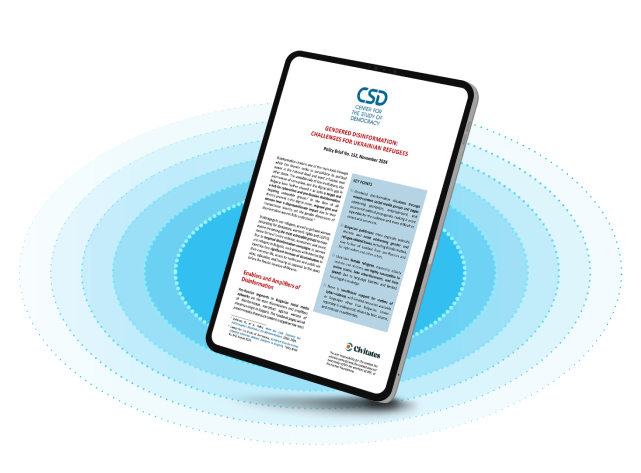

Gendered Disinformation: Challenges for Ukrainian Refugees examines how pro-Russian disinformation networks in Bulgaria target Ukrainian women and girls through misogynistic and identity-based narratives.
The policy brief maps how gendered disinformation circulates through mixed-content social media groups that combine patriotism, entertainment, and political messaging. This blending of content makes propaganda more digestible and harder to detect, allowing harmful narratives to spread organically within everyday digital spaces.
Amplifiers and coordinated networks
The report identifies pro-Russian Facebook pages as primary amplifiers of narratives portraying Ukrainian women as opportunistic, manipulative, or socially destabilising. These pages frequently combine anti-EU, anti-NATO, and anti-migrant rhetoric with messaging that reinforces traditional gender roles.
Data analysis reveals coordinated clusters of pages sharing identical articles from a small number of online outlets, often embedding links in comment sections to boost algorithmic engagement. Narratives such as a supposed “boom of marriages” between Ukrainian women and Bulgarian men, as well as claims linking refugees to disease or moral decay, circulated widely across these networks.
The brief also highlights the role of bridge accounts — including entertainment-focused pages — that connect mainstream audiences with politically charged disinformation ecosystems.
Policy and institutional context
The study situates online narratives within a broader domestic policy environment marked by political reluctance to address gender-related disinformation. Bulgarian politicians often avoid confronting these narratives due to concerns about backlash from pro-Russian or far-right constituencies.
The brief also identifies gaps between existing hate speech legislation and its practical enforcement, particularly in cases involving refugees or foreign-language victims. Under-reporting remains widespread due to language barriers, mistrust of authorities, and limited access to support services.
Cyberviolence and trafficking risks
The report highlights how online harassment can translate into real-world harm. Ukrainian refugee women face heightened exposure to scams, fake job offers, online sexual exploitation schemes, and trafficking risks that are amplified through social media platforms.
Support mechanisms remain fragmented, and gender-based cyberviolence is not yet comprehensively addressed within Bulgarian legislation.
Sensika’s contribution
Online media coverage and social media activity related to narratives targeting Ukrainian refugees were analyzed using Sensika’s media intelligence platform. The infrastructure enabled structured monitoring of content volume, narrative clustering, and coordinated amplification across Facebook networks.
All findings, interpretations, and policy recommendations remain those of the Center for the Study of Democracy.
Access the full report
Gendered Disinformation: Challenges for Ukrainian Refugees provides a structured assessment of amplification networks, institutional gaps, and policy measures aimed at protecting vulnerable communities in Bulgaria’s digital information space.