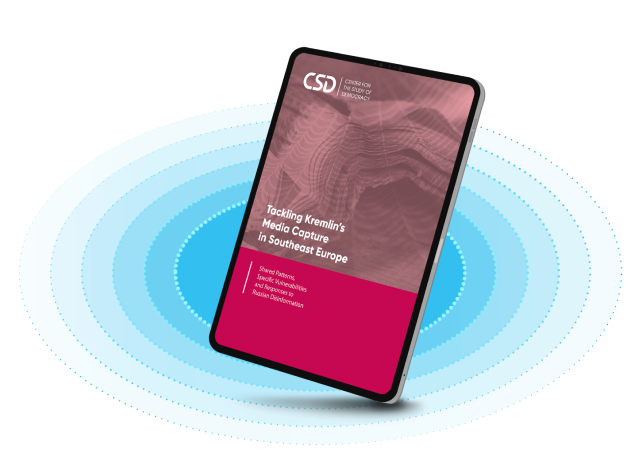

Tackling Kremlin’s Media Capture in Southeast Europe provides a comprehensive regional assessment of how Russia expands influence through the systematic capture and distortion of media ecosystems across Southeast Europe (SEE).
The report examines eight countries — Bulgaria, Croatia, Serbia, Bosnia and Herzegovina, Montenegro, North Macedonia, Albania, and Kosovo — mapping the intersection between political-economic dependencies, opaque ownership structures, and coordinated disinformation narratives.
Media capture as a strategic instrument
Rather than relying solely on overt state ownership of media outlets, the Kremlin’s strategy in SEE is characterized by informal networks of influence. These include:
- Financial leverage through advertising and state-owned companies
- Content republishing arrangements with Russian state media
- Political-business alliances embedded within domestic media markets
- Opaque ownership and regulatory loopholes
The report conceptualizes media capture as a hybrid form of institutional and economic influence that distorts editorial independence and weakens democratic accountability.
Narrative diffusion and amplification
Beyond ownership and financing patterns, the study conducts structured content analysis across four categories of media outlets in each country: directly Russia-owned, partisan, broader daily, and independent outlets.
The analysis focuses on EU- and NATO-related narratives and tracks:
- Narrative volume
- Publication peaks
- Diffusion strategies
- Cross-platform engagement
The findings show recurring disinformation narratives aligned with Kremlin geopolitical objectives, including anti-EU messaging, NATO skepticism, and framing authoritarian governance as a viable alternative.
Social media convergence
The report also examines the role of Russian embassies, Sputnik, and affiliated actors in social media spaces. In some countries, official embassy Facebook pages demonstrate higher engagement than traditional Russian state media outlets.
This convergence between formal diplomatic channels and informal media networks reinforces the cognitive dimension of media capture.
Sensika’s contribution
Automated quantitative diagnostics of narrative intensity and publication peaks were conducted using Sensika’s SaaS content tracking platform. The infrastructure enabled cross-country comparison of online presence, narrative diffusion patterns, and amplification dynamics across differentiated outlet types.
All findings, interpretations, and policy recommendations remain those of the Center for the Study of Democracy.
Access the full report
Tackling Kremlin’s Media Capture in Southeast Europe provides a region-wide framework for understanding how political-economic networks and disinformation narratives converge to shape public discourse.