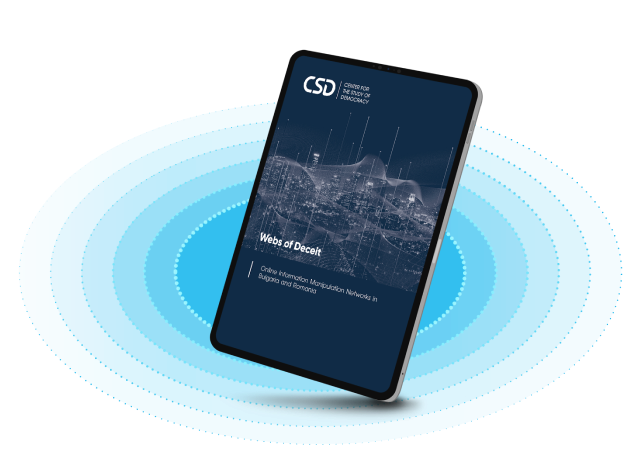

Webs of Deceit examines the structure and amplification dynamics of pro-Kremlin disinformation networks operating within Bulgaria’s online information ecosystem. The report provides a systematic mapping of coordinated media clusters, content duplication patterns, and cross-platform dissemination mechanisms.
Produced by the Center for the Study of Democracy (CSD), the study analyzes how networks of ideologically aligned outlets and social media channels sustain recurring narratives aligned with Russian geopolitical interests.
Coordinated publication ecosystems
The report identifies clusters of interconnected websites that replicate identical or near-identical content across multiple domains. These “mushroom websites” function as amplification multipliers, artificially increasing narrative visibility and perceived legitimacy.
Many of these outlets exhibit overlapping ownership signals, synchronized publication timing, and shared thematic framing. This structure enables rapid narrative scaling during key geopolitical developments, particularly those related to Ukraine, NATO, and EU policy decisions.
Narrative consistency and cross-platform reinforcement
The analysis highlights the persistence of several recurring themes, including:
- Framing NATO as a destabilizing force
- Portraying Western sanctions as self-destructive
- Amplifying claims of institutional collapse in the EU
- Recasting Russian geopolitical actions as defensive or justified
Telegram and Facebook ecosystems reinforce these narratives, often acting as accelerators during moments of political tension. Coordinated posting patterns create spikes in engagement and narrative penetration across digital spaces.
Structural vulnerabilities
Webs of Deceit emphasizes how Bulgaria’s fragmented media market and limited regulatory enforcement create an enabling environment for coordinated disinformation networks. Content duplication, monetization strategies, and opaque ownership structures contribute to sustained narrative visibility.
The report argues that understanding influence operations requires examining networks and infrastructure — not only individual pieces of misleading content.
Sensika’s contribution
Online media volume, source clustering, duplication patterns, and narrative amplification dynamics were analyzed using Sensika’s media intelligence platform. The monitoring infrastructure enabled structured tracking of thousands of Bulgarian news websites and identification of coordinated publication ecosystems over time.
All findings, interpretations, and policy recommendations remain those of the Center for the Study of Democracy.
Access the full report
Webs of Deceit provides a structured examination of coordinated disinformation networks and their impact on Bulgaria’s digital information environment.